The History of Remote Viewing: From Cold War Intelligence to Modern Practice
Remote viewing history is one of the stranger chapters of the Cold War. What sounds at first like science fiction—the attempt to describe a hidden or distant location without seeing it normally—was investigated for more than two decades through research connected to the U.S. intelligence and defense communities.
The story involves physicists, intelligence agencies, military personnel, experimental subjects, classified programs, and eventually thousands of pages of declassified government records.
Today, remote viewing continues outside government programs through researchers, independent viewers, training organizations, and different methodologies.
But where did it actually begin?
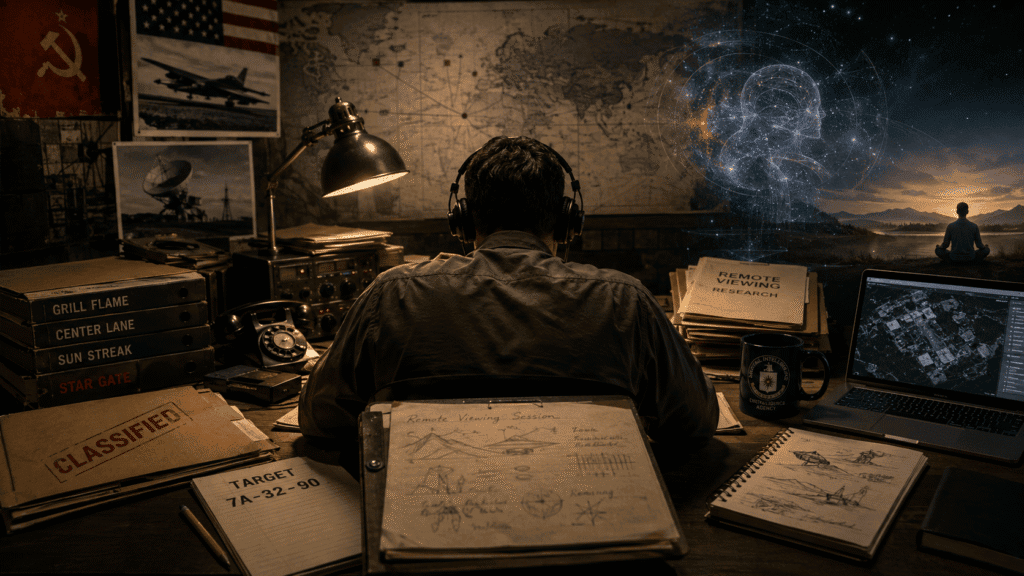
What Is Remote Viewing?
Remote viewing is an experimental process in which a person attempts to obtain information about a target that is hidden from their normal senses.
A target could be a location, structure, object, photograph, event, or other designated information.
In a typical blind session, the viewer does not know what the target is beforehand. Instead, the viewer records impressions such as shapes, textures, temperatures, colors, sounds, dimensions, movement, spatial relationships, and sometimes more complex conceptual information.
One of the most important distinctions is that remote viewing is a protocol, not simply another word for psychic ability.
The historical research attempted to place unusual perception under controlled conditions where information could be recorded before the target was revealed and later compared with feedback.
The Cold War Changes Everything
To understand why the United States became interested in remote viewing, we have to return to the Cold War.
The United States and Soviet Union were competing not only in nuclear weapons, aircraft, satellites, and conventional intelligence, but also in less conventional areas of research.
American intelligence became interested in reports of Soviet research into parapsychology and possible applications of anomalous cognition.
Whether these abilities actually worked was almost secondary to the initial strategic question.
What if the Soviets discovered something useful before the United States did?
The CIA states that its own research into psychic phenomena began in the summer of 1972. The goal was to investigate whether people could obtain information about locations and objects without physically being there.
That investigation would help begin the American government’s long and complicated relationship with remote viewing.
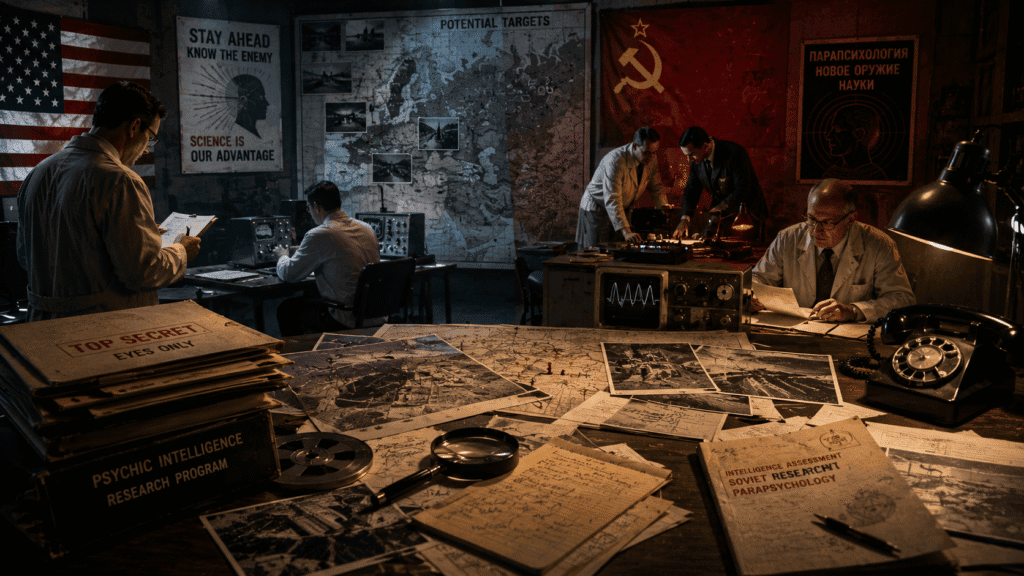
Stanford Research Institute
Much of the early research took place at Stanford Research Institute, now known as SRI International, in California.
Two of the most important researchers associated with this period were physicists Harold “Hal” Puthoff and Russell Targ.
One particularly important participant was artist and psychic researcher Ingo Swann.
Declassified SRI material describes experiments involving Swann and states that his apparent ability to describe details of remote geographical locations encouraged researchers to establish a program testing remote viewing under more controlled scientific conditions.
The researchers attempted to address obvious problems such as sensory leakage, accidental cueing and other ways a participant might obtain information normally.
Remote viewing was beginning to move from an unusual claim toward an experimental protocol.
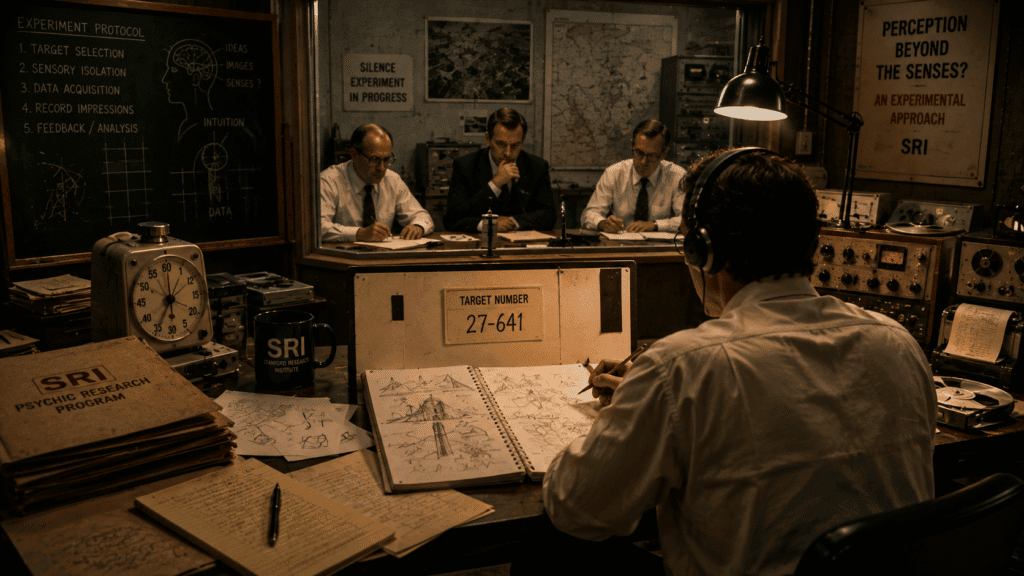
Ingo Swann and the Development of Remote Viewing
Ingo Swann would become one of the most influential figures in remote-viewing history.
Swann’s importance wasn’t limited to participating in experiments. He became deeply involved in thinking about how anomalous information was perceived and how a viewer might separate genuine impressions from imagination, interpretation and analytical thinking.
This distinction remains fundamental to remote-viewing practice.
A viewer might receive an immediate impression such as:
cold — metallic — tall — open — moving
The analytical mind may then decide:
“It’s a bridge.”
The first information consists of relatively basic impressions. The second is an interpretation.
Remote-viewing methodologies would increasingly attempt to teach viewers how to record the first type of information without allowing the analytical mind to dominate the session.
Pat Price and Other Early Viewers
Swann wasn’t the only person involved in the early experiments.
Another important figure was Pat Price, a former police commissioner and city councilman who became known for producing detailed remote-viewing material.
Other experimental participants included people such as Hella Hammid.
SRI documents describe multiple experiments involving Price, Hammid, Swann and other participants as researchers investigated whether descriptions of distant locations could be obtained under controlled conditions.
These early experiments helped establish many of the concepts that would become associated with remote viewing.
But the research was about to move beyond the laboratory.
From Experiment to Intelligence Tool
The intelligence community wanted to know whether remote viewing could do more than produce interesting experimental results.
Could it provide useful intelligence?
That question transformed remote viewing from primarily a research subject into a potential operational capability.
According to the CIA’s own historical account, the CIA ended its direct research program in 1977, after which responsibility moved into the Department of Defense/DIA environment.
Over the following years, the effort operated under several different names and organizational arrangements.
This is important because people often refer to the entire history simply as “Project Stargate.”
The reality is more complicated.
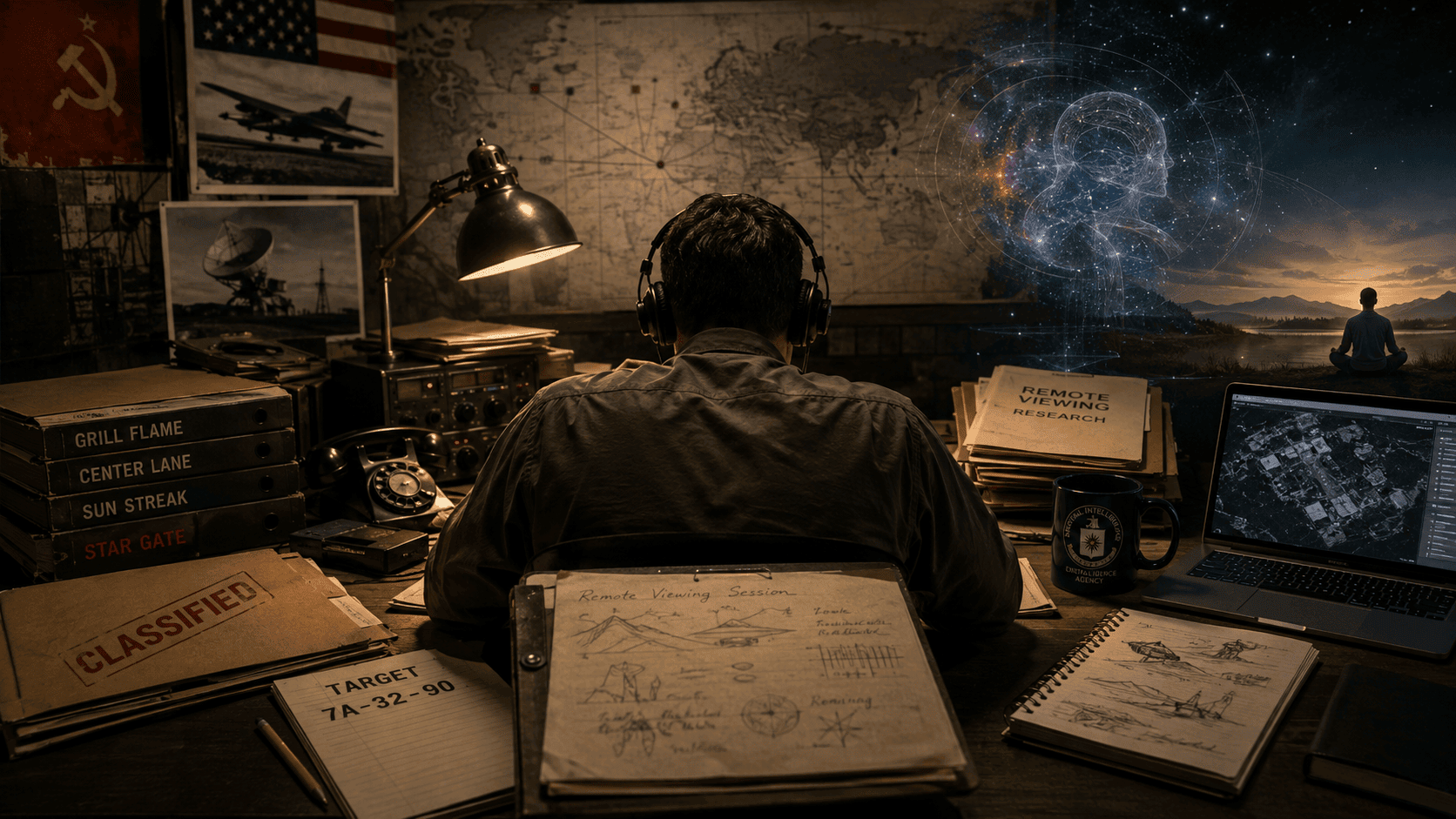
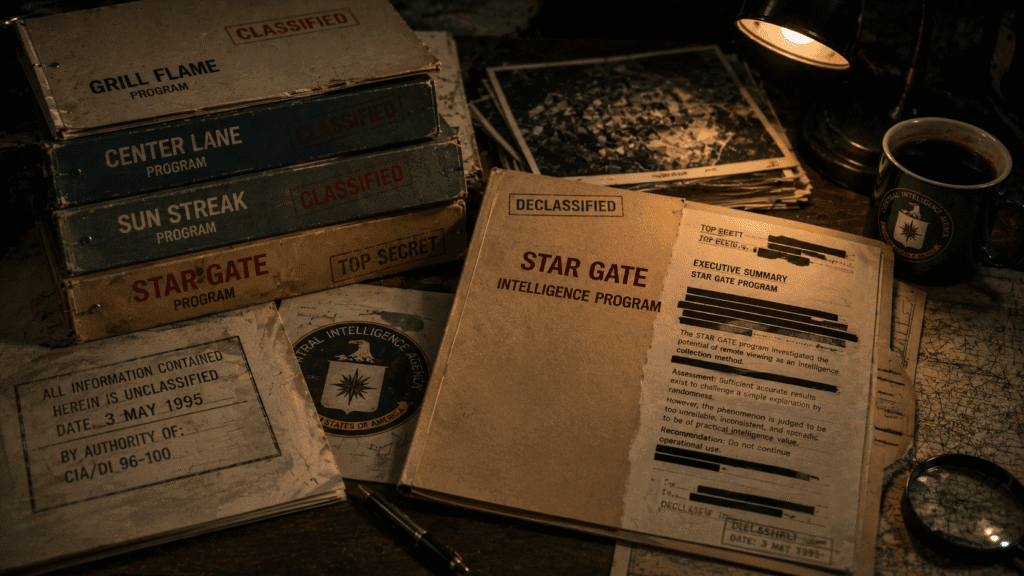
GRILL FLAME, CENTER LANE, SUN STREAK and STAR GATE
Different stages of the government’s remote-viewing work became associated with names including:
GRILL FLAME
CENTER LANE
SUN STREAK
and eventually:
STAR GATE
The names changed as organizations, management structures, objectives and administrative arrangements changed.
Because Stargate became the best-known name—especially after declassification—it is now frequently used as an umbrella term for much of the government’s remote-viewing history.
But the overall government involvement stretched across different programs and agencies.
The Military Remote Viewers
A particularly fascinating chapter came when military personnel themselves were trained to perform remote viewing.
Rather than relying exclusively on people already believed to possess unusual abilities, researchers explored whether the process could be taught.
That was a major conceptual change.
Remote viewing could potentially become a trainable skill.
This idea eventually contributed to the development of structured methodologies in which viewers followed stages and procedures rather than simply attempting to “be psychic.”
Several individuals who later became well known within the remote-viewing community emerged from this military environment.
The Development of Controlled Remote Viewing
Ingo Swann’s work contributed to what eventually became commonly known as Controlled Remote Viewing (CRV).
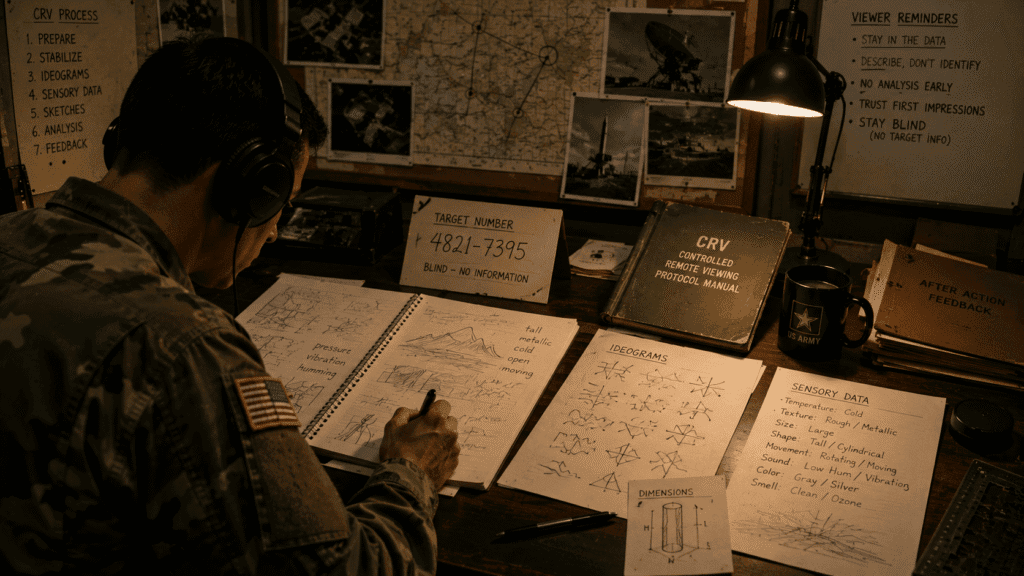
CRV attempts to structure the acquisition of information through a sequence of stages.
Instead of immediately trying to identify a target, a viewer begins with relatively basic information and gradually works toward increasingly complex data.
Depending on the methodology and training lineage, this can involve things such as:
- ideograms
- sensory information
- dimensional data
- sketches
- textures and temperatures
- sounds and smells
- movement
- spatial relationships
- conceptual information
One of the fundamental ideas is to prevent the analytical mind from taking control too early.
The objective isn’t necessarily:
“Tell me what the target is.”
It is more like:
“Describe the target.”
That difference is extremely important.
Remote Viewing Becomes Operational
Remote viewing wasn’t confined to training exercises.
Government records show that it was tasked against actual intelligence problems.
A declassified government summary states that from 1986 through the first quarter of fiscal year 1995, the Department of Defense paranormal psychology program received more than 200 operational tasks from military organizations requesting remote-viewing information unavailable through conventional sources.
Targets and questions could involve locations, facilities, people, activities and other intelligence problems.
The results, however, were controversial.
Remote viewers sometimes produced information considered interesting or accurate, but intelligence usefulness requires more than occasional correspondence with a target.
Information must be sufficiently specific, dependable and actionable.
That would ultimately become one of the central problems facing the program.
The Stargate Program
By the early 1990s, the program became formally associated with the name STAR GATE.
The program combined several areas of interest, including operational remote viewing, research into anomalous cognition and assessment of foreign parapsychology programs.
By this point, approximately two decades had passed since the CIA’s initial work in 1972.
Remote viewing had survived changing agencies, changing program names, skepticism, internal reviews and continuing controversy.
But the Cold War had ended.
The environment that created these programs was disappearing.
And government officials wanted an answer to a fundamental question:
Was remote viewing actually useful for intelligence collection?
The 1995 Evaluation
In the mid-1990s, the program returned to CIA oversight for evaluation.
An independent review was commissioned through the American Institutes for Research (AIR).
The evaluation became one of the most debated events in remote-viewing history.
The CIA’s own summary says the review concluded that enough accurate remote-viewing results existed to challenge a simple explanation by randomness, but that the phenomenon was too unreliable, inconsistent and sporadic to provide useful intelligence.
An operational assessment similarly concluded that the usefulness of remote viewing for intelligence collection could not be substantiated.
That distinction remains important.
The debate wasn’t simply:
“Did anything happen?”
It was also:
“Can whatever is happening reliably produce intelligence that analysts can use?”
Those are two very different questions.
Jessica Utts and Ray Hyman
The scientific debate surrounding the 1995 review is particularly interesting because experts did not interpret the evidence identically.
Statistician Jessica Utts argued that the experimental evidence supported the existence of anomalous cognition strongly enough that continued proof-oriented experiments were no longer the most useful direction.
Psychologist and skeptic Ray Hyman disagreed with stronger conclusions about what had been demonstrated and emphasized methodological concerns and the need for independent replication.
That disagreement continues to represent the larger debate surrounding remote viewing today.
Supporters point toward statistically significant experimental results, successful sessions and unusual correspondences between blind descriptions and targets.
Skeptics point toward methodological issues, inconsistent performance, subjective judging, failed sessions and difficulties independently establishing the phenomenon.
Both parts of that history matter.
The End of the Government Program
In 1995, the U.S. government’s remote-viewing program effectively came to an end.
The CIA decided not to restore the program following the evaluation.
But something unexpected happened.
The story became public.
Documents associated with the programs were declassified, eventually giving researchers and ordinary people access to material that had previously been hidden behind government secrecy.
The CIA’s electronic archives now contain a large collection of STAR GATE-related records.
Anyone willing to spend the time can explore many of those documents.
That changed remote viewing forever.
Remote Viewing Leaves the Military
After the government program ended, former participants began teaching, writing books, giving interviews and developing organizations outside the intelligence community.
Different training lineages emerged.
Among the best known are:
Controlled Remote Viewing — CRV
Derived from the structured work associated with Ingo Swann and the military remote-viewing program.
Extended Remote Viewing — ERV
A less rigid approach generally involving a deeply relaxed state and longer periods of attention to the target.
Technical Remote Viewing — TRV
A later methodology derived from elements of the earlier structured remote-viewing systems.
Hawaii Remote Viewers’ Guild — HRVG
The Hawaii Remote Viewers’ Guild, founded by Glenn Wheaton, developed its own methodology and training structure, including techniques designed to obtain visual, sensory and other forms of target information.
Other schools and independent methods have also appeared.
Although they may differ considerably in terminology and technique, they share a central concept:
The viewer should be blind to the target and produce information before receiving feedback.
Why Blind Targeting Matters
Blindness is arguably one of the most important principles in serious remote-viewing practice.
If I already know the target is the Eiffel Tower, describing:
tall — metallic — lattice structure
isn’t impressive.
I already knew what I was supposed to describe.
But if I’m given nothing except something like:
4821-7395
and I record:
tall — metallic — narrowing upward — open space — large structure
before discovering that the target was the Eiffel Tower, the situation becomes much more interesting.
That still doesn’t automatically prove a paranormal explanation.
But it creates something that can be examined.
This is why target preparation, blinding, documentation and feedback are so important.
Remote Viewing in the Internet Era
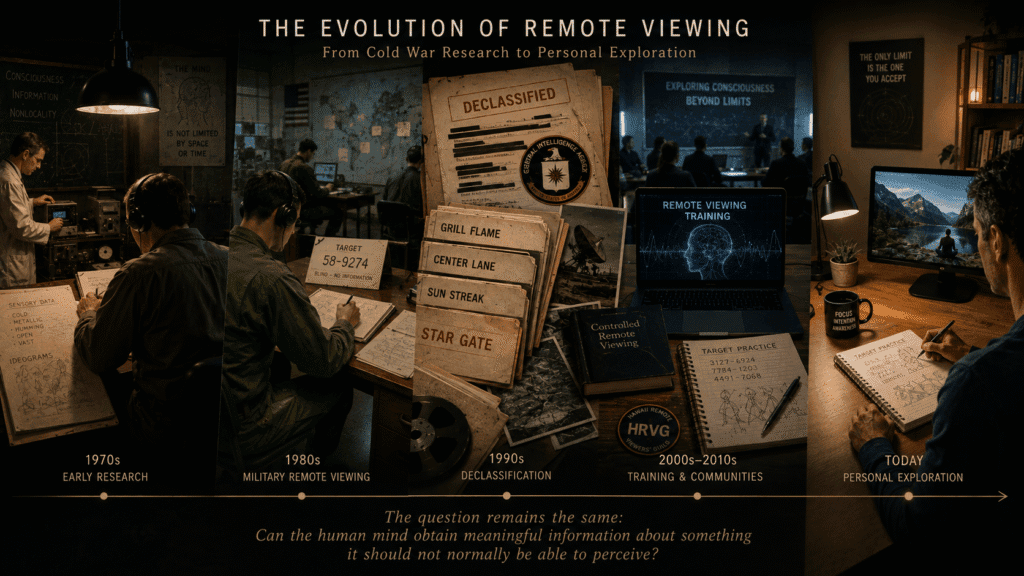
Remote viewing has changed dramatically since the 1970s.
A practice that once existed inside classified laboratories and military units can now be explored by almost anyone.
Declassified documents are online.
Former military viewers have published books.
Training videos exist.
Communities conduct blind targets.
People upload complete sessions before feedback is revealed.
Modern technology also makes it possible to timestamp sessions, record video, digitally commit targets and create better controls against accidental information leakage.
In some ways, remote viewing has become easier to test independently than it ever was during the Cold War.
Remote Viewing Still Hasn’t Settled the Bigger Question
More than fifty years after the CIA began investigating the subject, remote viewing remains controversial.
The government investigated it.
Experiments produced results that generated scientific debate.
Military viewers were trained.
Operational intelligence tasks were conducted.
Programs existed under multiple names.
And eventually the government concluded that remote viewing was not reliable enough to justify continued use as an intelligence-collection capability.
Those are historical facts.
The larger interpretation remains disputed.
If remote viewing represents genuine information acquisition beyond the conventional senses, its implications would reach far beyond intelligence gathering.
It would raise questions about consciousness itself.
Where does the information come from?
How does the brain access it?
Why are some sessions remarkably accurate while others completely miss?
Can performance be improved?
And perhaps most importantly:
Is consciousness limited to the brain in the way we normally assume?
We still don’t have universally accepted answers.
From Secret Program to Personal Experiment
That may be the most fascinating part of remote-viewing history.
It began as an obscure area of parapsychological research.
The Cold War turned it into an intelligence question.
Scientists attempted to test it.
The military attempted to train it.
Intelligence agencies attempted to use it.
Government reviewers questioned its practical reliability.
The programs were eventually shut down and declassified.
And now the experiment has moved outside the laboratory and intelligence world.
Today, someone can sit at a desk with nothing more than a pen, paper and a blind target number and attempt the same fundamental experiment:
Can the human mind obtain meaningful information about something it should not normally be able to perceive?
You don’t have to believe the answer is yes.
You don’t have to believe the answer is no.
You can run the experiment.
And more than fifty years after the first American government research began, that question is still being explored.