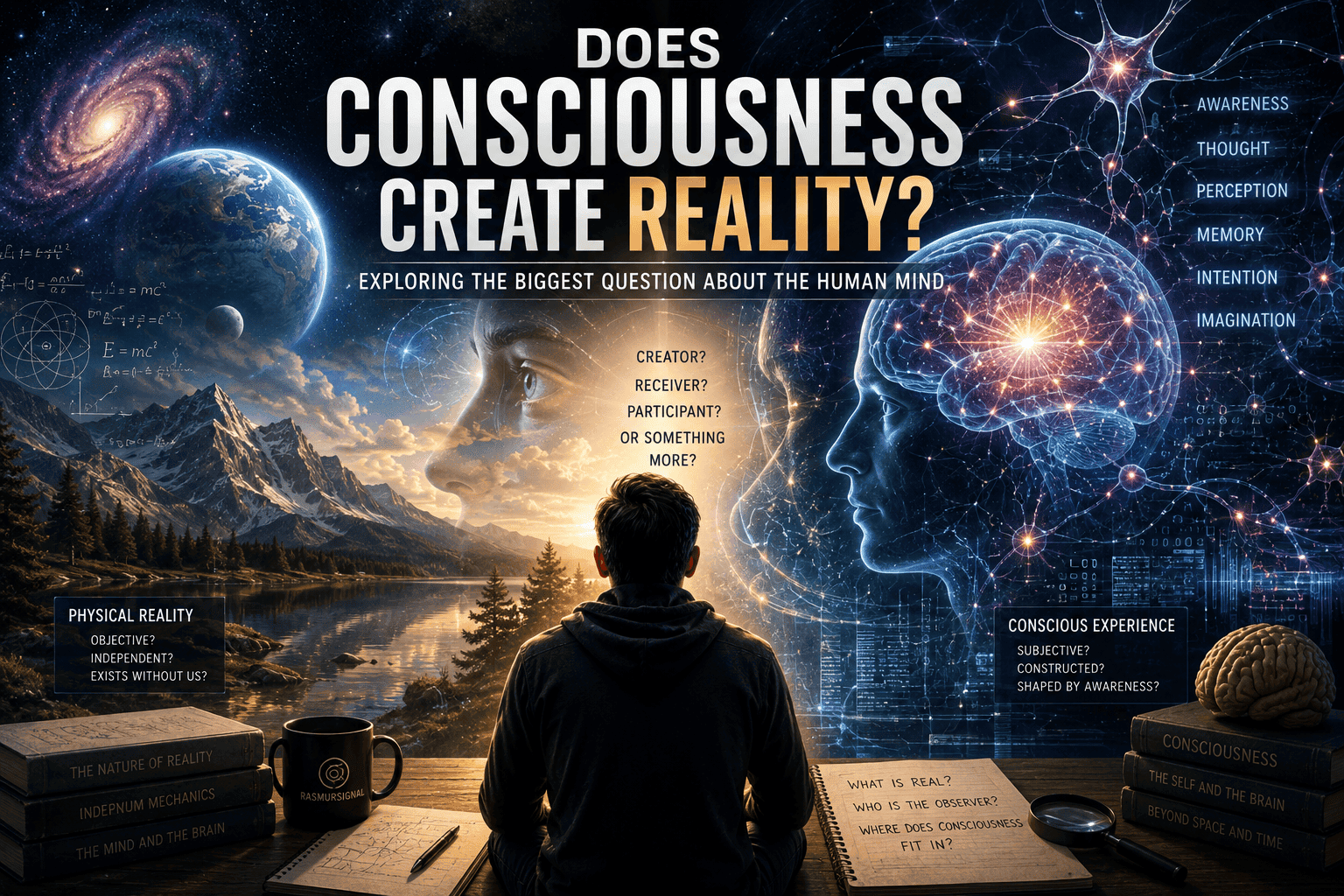
Does Consciousness Create Reality?
Does consciousness create reality, or does consciousness simply experience a reality that already exists? This question sits at the intersection of neuroscience, philosophy, quantum physics, psychology, and consciousness research.
At first, the idea that consciousness creates reality can sound impossible. The physical universe existed long before humans appeared. Stars formed billions of years ago, planets developed, and mountains existed without anyone observing them. From this perspective, reality clearly appears capable of existing independently of human consciousness.
But there is another side to the question.
We don’t experience the physical world directly. Our senses collect information from the environment, and the brain processes, filters, predicts, and interprets that information before it reaches conscious awareness. What we experience as reality is therefore partly constructed through perception.
This gives us an important distinction when asking does consciousness create reality.
Consciousness clearly helps create our experience of reality. What remains controversial is whether consciousness can actually influence reality outside the brain.
Could consciousness affect physical events? Could information exist beyond our normal sensory awareness? Could phenomena such as meditation, synchronicity, intuition, or remote viewing reveal something deeper about the relationship between consciousness and reality?
Science has not established that simply thinking about something causes physical reality to reorganize itself around that thought. But consciousness itself remains one of science’s greatest unanswered questions.
So instead of beginning with the assumption that consciousness does—or does not—create reality, let’s examine what we actually know.
You Don’t Experience Reality Directly
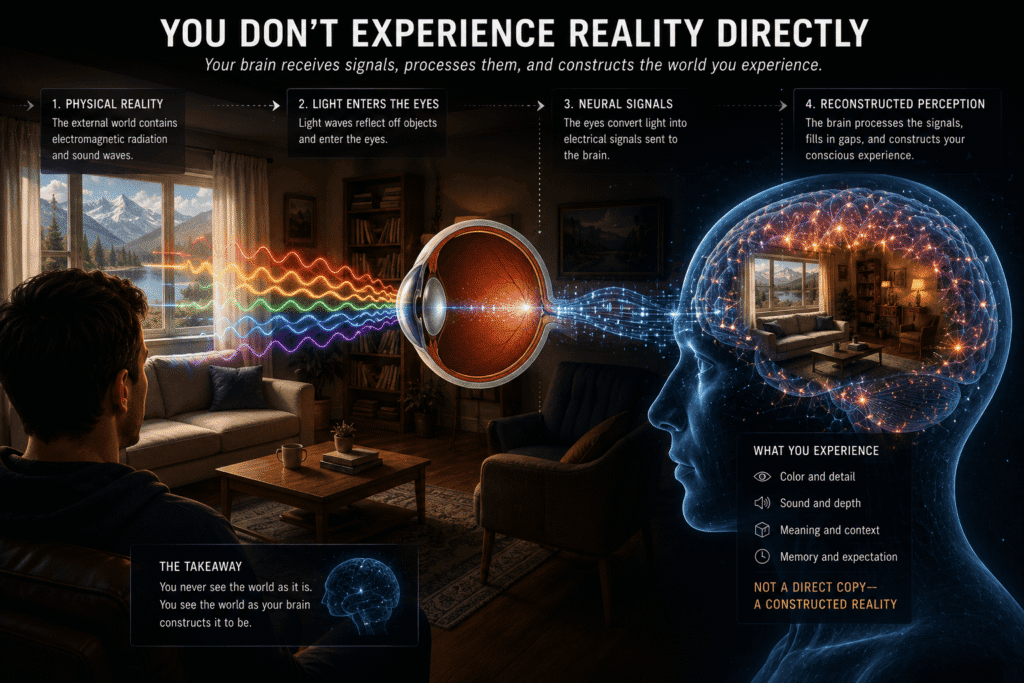
When asking does consciousness create reality, we first have to understand something surprising: you don’t experience the external world directly.
Look around you. The room, your computer, the colors around you, and the sounds you hear all seem completely real and immediate. It feels as though consciousness is simply observing a finished physical world.
But that’s not exactly what happens.
Light reflects from objects and enters your eyes. Your visual system converts that light into electrical signals, which are processed throughout the brain. Sound works similarly: vibrations in the environment reach your ears, are converted into neural signals, and are interpreted by the brain.
Only after all of this processing do you experience the world you recognize as reality.
This becomes important when considering whether consciousness creates reality. The physical world may exist independently of us, but the reality we consciously experience is constructed from information gathered and interpreted by our nervous system.
Consider the color red. An object reflects particular wavelengths of electromagnetic radiation, but the subjective experience of redness exists within conscious perception. The wavelength itself doesn’t contain the experience of red as you know it.
The same applies to sound, taste, smell, depth, and many other aspects of perception.
So when we ask does consciousness create reality, we may actually be asking two different questions:
Does consciousness create physical reality?
Or:
Does consciousness create our experience of physical reality?
Science provides strong evidence that the brain actively constructs our conscious experience from sensory information. What remains unresolved is whether consciousness does anything beyond interpreting the information supplied by the brain.
Understanding that distinction is essential before exploring the much bigger claim that consciousness can influence reality itself.
The Color Red Doesn’t Exist the Way You Experience It
Imagine a bright red apple.
The apple reflects particular wavelengths of electromagnetic radiation.
Your eyes detect that information.
Your nervous system processes it.
Then something extraordinary happens.
You experience:
red.
But where exactly is “red”?
The electromagnetic wave isn’t experiencing redness.
The apple isn’t necessarily experiencing redness.
Your brain converts physical information into a subjective conscious experience.
This is one of the great mysteries of consciousness.
Science can trace many of the processes between light entering your eye and activity occurring in your brain.
But explaining why that activity produces the subjective experience of redness is much harder.
Your reality is already partly constructed.
Your Brain Is Constantly Guessing
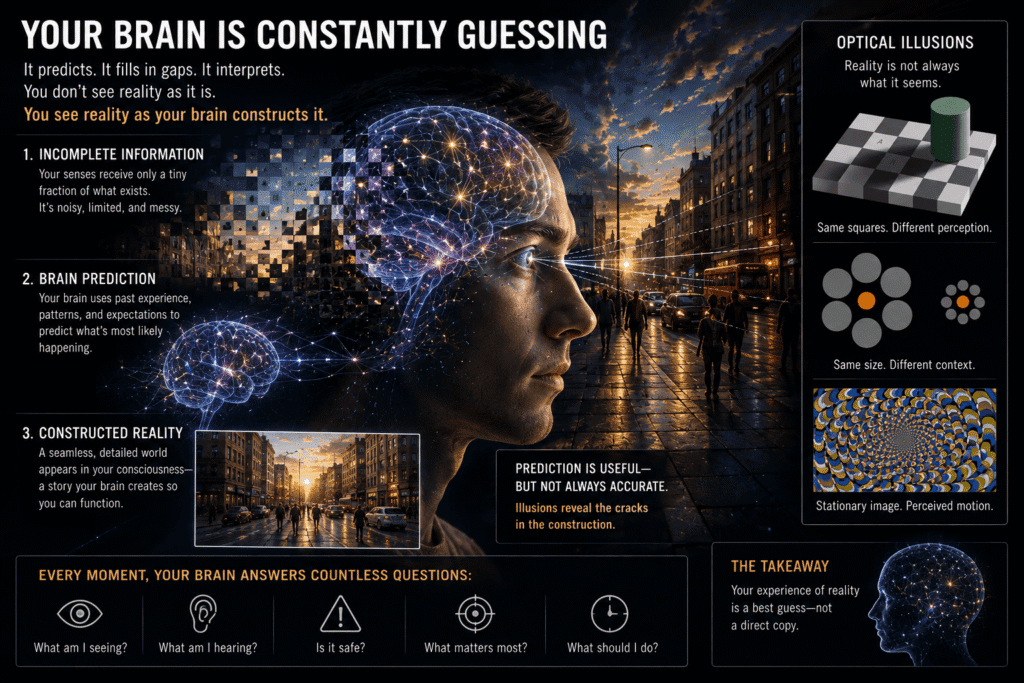
To understand does consciousness create reality, we also need to understand that the brain is not simply a camera recording everything around us. It is constantly filtering, predicting, interpreting, and filling in missing information.
At any moment, your senses receive enormous amounts of information. You cannot consciously process all of it, so the brain decides what deserves your attention and what can be ignored.
Think about your nose. It has been visible throughout the entire time you’ve been reading this article, but you probably weren’t consciously noticing it until I mentioned it. The visual information was always there. Your brain simply decided it wasn’t important.
Nothing about physical reality changed.
Your conscious experience of reality changed.
Optical illusions provide another example. Two objects can be physically identical but appear different because of their surroundings. A stationary image can appear to move. Colors can seem brighter or darker depending on their context.
These illusions demonstrate that what we consciously perceive isn’t always a perfect representation of the physical world.
This is important when asking does consciousness create reality because it reveals a distinction between the world itself and the world we experience.
The brain appears to construct a useful model of reality using sensory information, previous experiences, expectations, memories, and predictions.
In that sense, saying consciousness creates reality isn’t necessarily a supernatural claim. Our conscious experience is already an interpretation of information rather than a perfect copy of the outside world.
The much bigger question is whether this process stops inside our heads.
Does consciousness create reality only at the level of perception, or can consciousness somehow influence the physical world itself?
That is where the question becomes far more controversial.
Attention Changes Your Reality
Another important part of asking does consciousness create reality is understanding the power of attention. What you focus on can dramatically change what becomes part of your conscious experience, even when nothing in the physical environment has changed.
Imagine buying a particular model of car. Suddenly, you begin seeing that same car everywhere. It can feel as though hundreds of people suddenly bought the exact vehicle you just purchased.
Of course, the cars were probably already there.
What changed was your attention.
Your brain began treating that particular car as important information, so you started consciously noticing something that previously blended into the background.
The same process happens with ideas, words, opportunities, fears, people, and patterns. Once something becomes important to us, we often begin noticing it everywhere.
This gives us another perspective on does consciousness create reality.
Consciousness may not have caused those cars, people, or events to appear. Instead, attention changed which parts of reality entered conscious awareness.
This distinction becomes especially important when discussing synchronicity and manifestation. Sometimes an experience that feels like consciousness creates reality may actually involve consciousness becoming more sensitive to information that was already present.
But attention can also produce real changes in the external world.
What we notice influences what we think about. What we think about influences our decisions. Our decisions influence our behavior, and our behavior can change the physical world around us.
So there is already a chain connecting consciousness and reality:
Attention → Perception → Thought → Decision → Action → Physical Change
When asking does consciousness create reality, therefore, we shouldn’t think of the answer as simply yes or no.
Consciousness clearly shapes the reality we experience, and through our actions it can shape the physical reality around us.
The unresolved question is whether consciousness can influence external reality without normal physical action.
That’s where the discussion becomes much more interesting.
Expectations Can Change Experience
When asking does consciousness create reality, we also need to consider how strongly expectations can influence what we experience.
If you believe something is dangerous, your body can react before you have confirmed that a real threat exists. Your heart may beat faster, your muscles may tighten, and your attention can become focused on anything that appears threatening.
The external situation may not have changed, but your experience of reality certainly has.
The placebo effect provides another interesting example. Expectations can sometimes influence subjective experiences such as pain and can be associated with measurable physiological responses. This doesn’t mean that positive thinking can cure every illness or that consciousness can simply override biology.
Instead, it demonstrates that the boundary between mental experience and physical processes in the body is more complicated than it may first appear.
This matters when discussing whether consciousness creates reality. Thoughts aren’t completely disconnected from the physical world. They occur within a biological system and can influence emotions, behavior, attention, stress responses, and other bodily processes.
But we need to make an important distinction.
Evidence that thoughts can influence the body does not automatically prove that thoughts can directly influence distant objects, random events, or the external universe.
So, does consciousness create reality?
We know consciousness can change how reality is perceived and influence what happens through the body and behavior. Whether consciousness can directly affect physical reality without a conventional mechanism remains a much bigger—and far more controversial—question.
Your Thoughts Also Change the External World
When asking does consciousness create reality, there is one way in which the answer is clearly yes: conscious thought can lead to actions that physically change the world.
Look around you.
Buildings, computers, airplanes, smartphones, satellites, bridges, and entire cities began as ideas before they became physical objects. Someone imagined something that didn’t yet exist and then turned that idea into reality through planning and action.
A computer begins as an idea. Engineers create designs. Programmers write software. Factories manufacture components. Eventually, something that once existed only as a concept becomes a physical object.
In this sense, consciousness creates reality through action.
Your own life works the same way. A goal begins as a thought. That thought can influence your decisions, those decisions influence your behavior, and repeated actions can eventually produce measurable changes in the physical world.
This gives us a clear relationship between consciousness and reality:
Thought → Intention → Decision → Action → Physical Change
But this still isn’t the extraordinary claim people usually mean when they ask does consciousness create reality.
The much bigger question is whether consciousness can influence physical events without conventional physical action.
Can intention affect something at a distance?
Can consciousness interact with random physical systems?
Can observation influence an outcome simply because a conscious observer is involved?
These questions take us into a much more controversial area—and eventually into one of the most misunderstood subjects in discussions about consciousness:
quantum mechanics.
This Is Where Quantum Mechanics Enters the Conversation
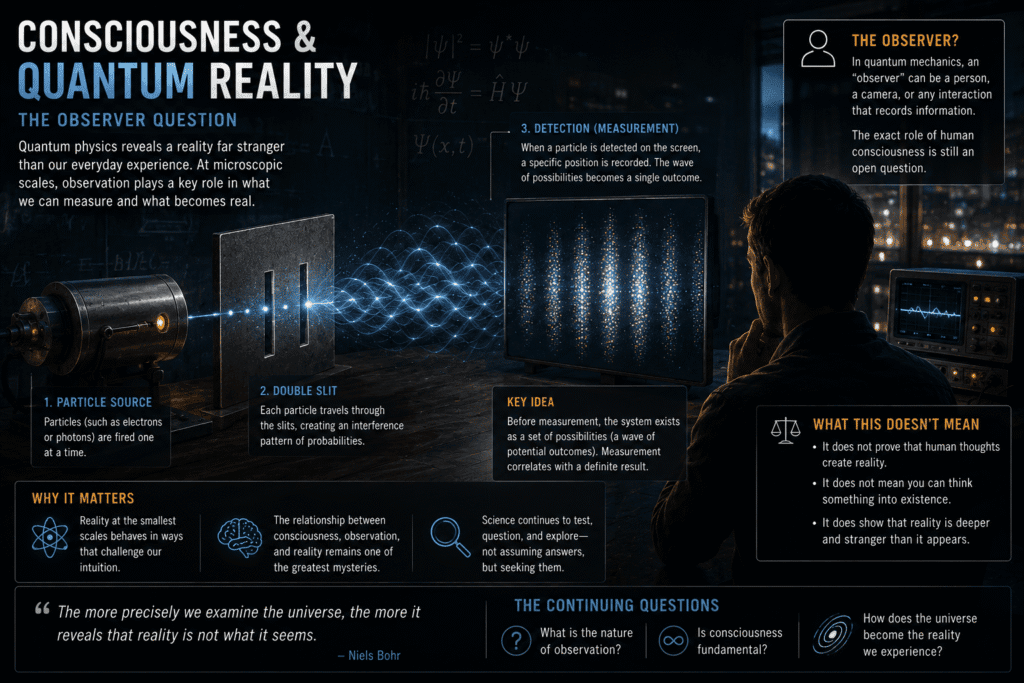
When people ask does consciousness create reality, quantum physics is often presented as evidence that the answer must be yes. The famous double-slit experiment, wave-particle behavior, superposition, and the role of measurement can make it sound as though reality doesn’t become real until a conscious person observes it.
But this interpretation goes much further than the science currently supports.
In quantum mechanics, an observer does not necessarily mean a conscious human mind. Measurement can involve a physical interaction between a quantum system, measuring equipment, and the surrounding environment. A person does not necessarily need to be watching the experiment for that interaction to occur.
This means the strange behavior observed in quantum experiments does not establish that human thoughts create physical reality.
However, quantum mechanics does reveal something profound: at very small scales, reality does not behave according to the intuitive rules we experience in everyday life. Probability, measurement, and the relationship between a system and its environment become extremely important.
Different interpretations of quantum mechanics attempt to explain what these observations ultimately mean, and physicists still debate fundamental questions about measurement and the nature of reality.
So, does consciousness create reality according to quantum physics?
At present, science cannot say that it does.
The more accurate conclusion is that quantum mechanics demonstrates that reality is stranger and less intuitive than it appears, while the exact relationship between consciousness and fundamental physical reality remains an open philosophical and scientific question.
And that distinction matters.
If we want to seriously investigate whether consciousness creates reality, we shouldn’t use quantum physics as proof of something it hasn’t established. Instead, we should look for phenomena that can actually be tested.
One of the most controversial examples is remote viewing.
The Observer Question Is Still Fascinating
Even after removing the exaggerated claims, the relationship between observation and reality remains philosophically fascinating.
Before measurement, quantum systems can be represented by combinations of possible outcomes.
Measurement produces a definite recorded result.
What exactly counts as a measurement?
Where does the quantum world become the classical world we experience?
Different interpretations give different answers.
Some interpretations don’t require consciousness at all.
Historically, however, some physicists and philosophers have explored whether consciousness could have some fundamental relationship with measurement.
That possibility remains controversial.
The responsible position isn’t:
“Quantum physics proves consciousness creates reality.”
It’s:
“Quantum physics demonstrates that reality is much stranger than our everyday experience suggests, while the role of consciousness remains unsettled.”
What About Synchronicity?
Another phenomenon that makes people question the relationship between consciousness and reality is .
Carl Jung used the term to describe meaningful coincidences that appear connected psychologically even when no obvious causal mechanism connects them.
You think intensely about someone you haven’t spoken to in years.
Your phone rings.
It’s them.
You repeatedly encounter the same unusual symbol during an important period in your life.
A book containing exactly the idea you’ve been struggling with unexpectedly appears at precisely the right moment.
These experiences can feel profound.
But humans are also extraordinary pattern-recognition machines.
We remember unusual coincidences and forget thousands of non-coincidences.
If you think about twenty people during a week and one unexpectedly contacts you, that event becomes memorable.
The nineteen who didn’t contact you disappear from the story.
So synchronicities shouldn’t automatically be treated as evidence that consciousness controls reality.
But they can still raise interesting questions about attention, probability, meaning, and how the mind organizes experience.
Remote Viewing Makes the Question Harder
Remote viewing introduces an even stranger problem.
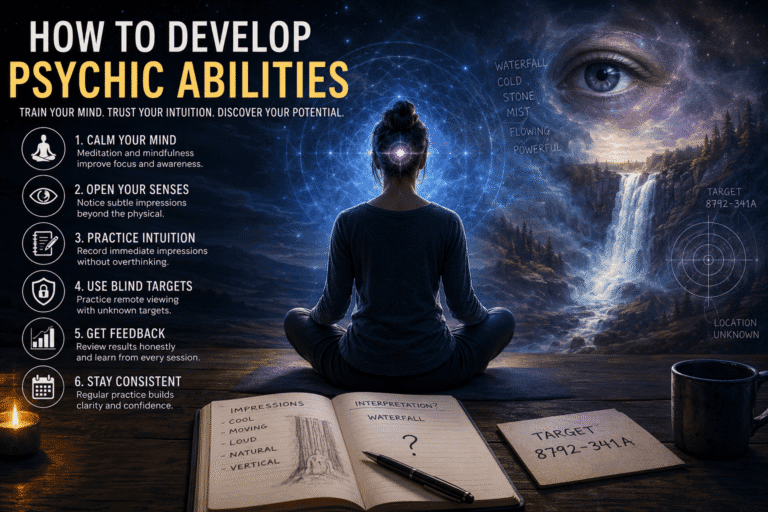
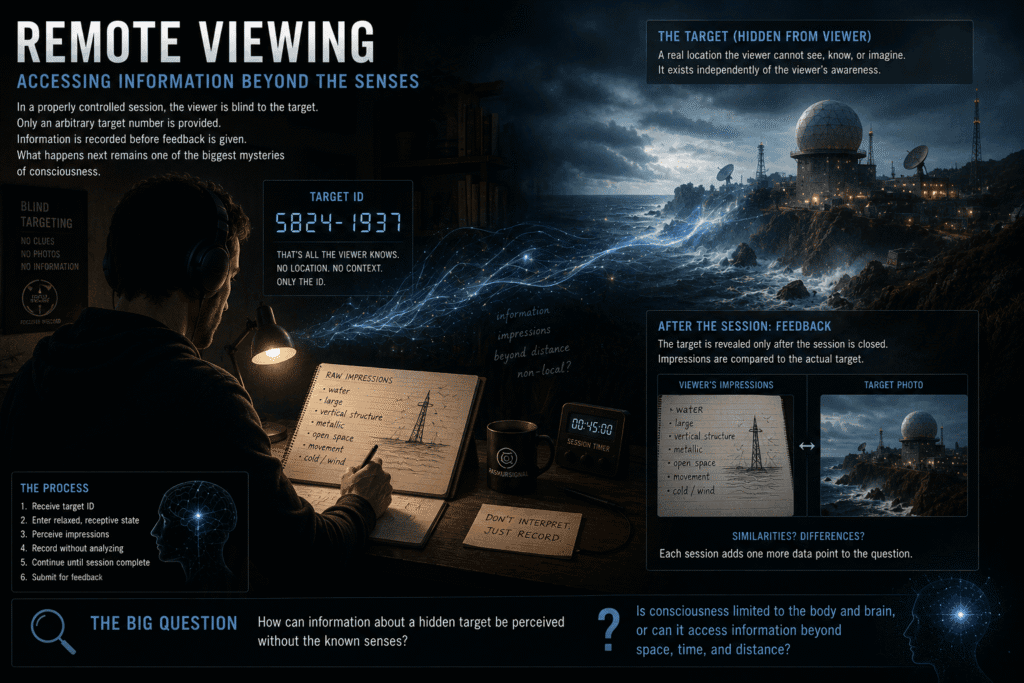
In a properly blinded remote-viewing session, the viewer attempts to describe a target without knowing what it is.
They might receive only an arbitrary identifier:
5824-1937
The viewer then records impressions before seeing the target.
Imagine they write:
water
large vertical structure
metallic
open space
movement
cold
and draw something resembling a tall structure beside water.
Then the feedback photograph reveals a large suspension bridge.
What happened?
One possibility is coincidence.
Another is subconscious cueing or information leakage.
Another is subjective interpretation after feedback.
Those possibilities must always be considered.
But if anomalous information transfer can be repeatedly demonstrated under properly controlled conditions, another possibility emerges:
Perhaps consciousness can access information in ways our current models don’t completely explain.
That still wouldn’t necessarily mean consciousness creates reality.
It might mean consciousness can access more of reality than we normally assume.
That’s an important distinction.
Remote Viewing the Future Creates an Even Bigger Problem
Some remote-viewing experiments and practitioners claim that targets involving future events can sometimes be described before those events occur.
This is often discussed in terms of precognition or predictive remote viewing.
If genuine precognitive information could be reliably demonstrated, the implications would be enormous.
Our everyday understanding of time looks like:
Past → Present → Future
The past happened.
The present is happening.
The future doesn’t exist yet.
But what if information about future states can sometimes be accessed?
That might suggest our intuitive experience of time doesn’t describe the full structure of reality.
Again, this remains controversial.
But it introduces an important alternative to the idea that consciousness creates reality.
Maybe consciousness doesn’t create the future.
Maybe consciousness can sometimes access information from a reality in which time behaves differently from how we experience it.
Does Observation Change the Future?
Now we reach an even stranger thought experiment.
Suppose someone remote views a future event.
Then they receive information about that future.
They decide they don’t like what they saw.
So they change their behavior.
Now the predicted event doesn’t happen.
What did they originally perceive?
One possible future?
A probability?
A fixed event that somehow changed?
Or simply incorrect information?
These questions quickly enter philosophical territory because we don’t currently have enough evidence to answer them confidently.
But they reveal how deeply consciousness, information, causality, and time are connected in the questions surrounding remote viewing.
Manifestation and the Law of Attraction
Another popular claim is that consciousness can create reality through manifestation.
The basic idea is that intensely thinking about or emotionally aligning with an outcome causes the universe to produce that outcome.
There is an important distinction here.
Visualization can absolutely change behavior.
If you repeatedly visualize starting a business, you may become more motivated to research opportunities.
You notice people who can help.
You take risks you previously avoided.
You work harder.
Those behavioral changes increase the probability of achieving the outcome.
That doesn’t require a supernatural mechanism.
Consciousness changed behavior.
Behavior changed reality.
The stronger claim—that thought alone directly rearranges external events—is much harder to demonstrate scientifically.
We should distinguish those two mechanisms instead of combining them.
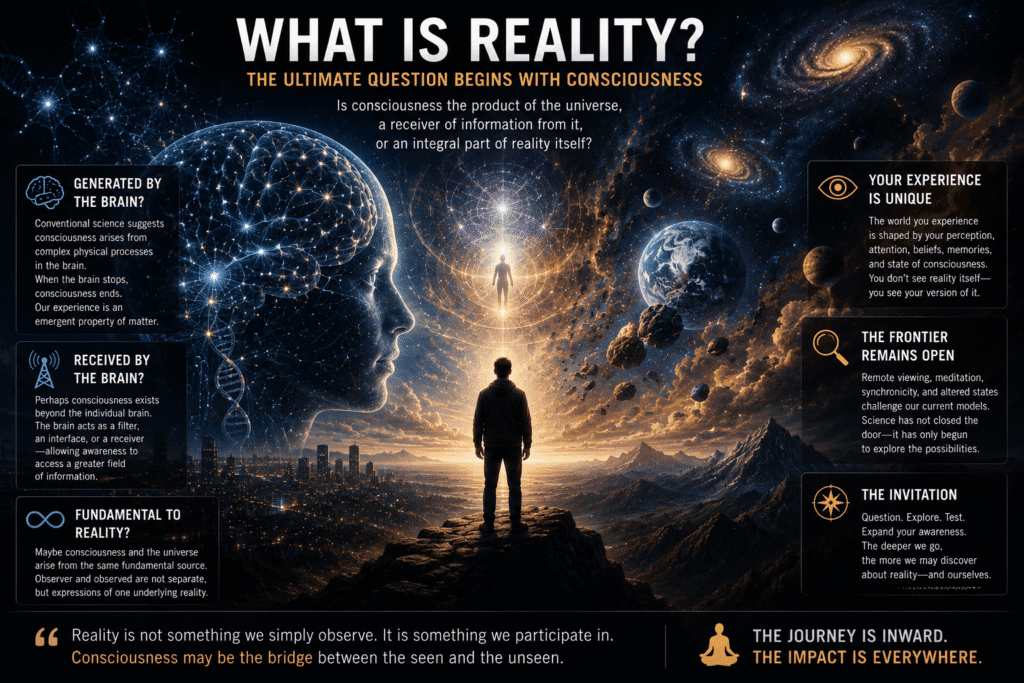
Consciousness Might Be Fundamental
Most conventional scientific approaches begin with matter.
Matter exists.
Brains develop.
Brains eventually produce consciousness.
But some philosophers and scientists have explored alternatives.
Perhaps consciousness isn’t something that suddenly appears after matter becomes complicated enough.
Perhaps consciousness—or something related to experience—is a fundamental aspect of reality.
Ideas such as panpsychism explore versions of this possibility.
Other philosophical approaches treat information, consciousness, or observation as more fundamental than our everyday material picture suggests.
None of these ideas currently proves remote viewing, manifestation, or psychic phenomena.
But they demonstrate something important:
We do not have a universally accepted explanation of consciousness.
That leaves room for investigation.
Not unlimited belief.
Investigation.
Maybe the Question Is Backwards
We normally ask:
Does consciousness create reality?
But perhaps that’s not the best question.
Maybe consciousness and reality aren’t completely separate things.
Think about a dream.
Inside a dream, you experience locations, people, objects, movement, fear, happiness, and time.
The dream feels like a world.
Yet the observer and the observed world are somehow connected within the same system.
I’m not suggesting physical reality is literally a dream.
But the example reveals how difficult it can be to separate experience from the experiencer.
Perhaps consciousness isn’t standing outside reality looking inward.
Perhaps consciousness is itself part of the structure of reality.
If that’s true, asking whether consciousness creates reality could be similar to asking whether waves create the ocean.
The relationship may be more fundamental than the question assumes.
Three Possibilities
At this point, I think there are at least three broad possibilities worth considering.
1. The Brain Creates Consciousness
The conventional position.
Physical processes in the brain generate conscious experience.
When the brain stops functioning permanently, consciousness ends.
Remote-viewing results would therefore need explanations involving conventional psychology, methodological problems, coincidence, or currently unidentified physical processes.
2. The Brain Receives or Filters Consciousness
In this model, consciousness exists beyond the individual brain, and the brain limits, organizes, or interfaces with it.
Remote viewing could theoretically represent moments when information enters awareness through this larger system.
This remains speculative and isn’t established neuroscience.
3. Consciousness Is Fundamental to Reality
Perhaps consciousness isn’t produced by matter or transmitted into matter.
Perhaps consciousness and physical reality emerge from something deeper.
Under this model, the division between observer and universe may not be as absolute as it appears.
Again, fascinating.
But not proven.
The Experiment Matters More Than the Belief
I think discussions about consciousness often make the same mistake.
People choose their answer first.
Then they search for evidence supporting it.
One side says:
“Consciousness obviously creates reality.”
Another says:
“That’s impossible.”
Both positions can stop investigation.
A better approach is experimentation.
If consciousness can affect random physical systems, test it.
If people can remote view, blind the target and record the results.
If precognition exists, preregister predictions before the event.
If meditation changes perception, measure it.
If consciousness affects biological systems, design controlled experiments.
And most importantly:
Record the failures too.
Extraordinary results become much more interesting when the experiment was designed so that failure was genuinely possible.
So, Does Consciousness Create Reality?
The answer depends on what we mean by reality.
Does consciousness create our subjective experience of reality?
Absolutely, in the sense that perception is constructed through the brain’s interpretation of sensory information.
Can consciousness change physical reality through our decisions and actions?
Obviously.
Every human-made object around us demonstrates that.
Can expectations and mental states influence the body?
There is substantial evidence that psychological states and physiological processes interact.
But can consciousness directly influence external physical reality without conventional physical mechanisms?
That remains an open and controversial question, not an established scientific fact.
And does consciousness exist independently of the brain?
We don’t know.
Perhaps We’re Asking the Most Important Question
For centuries, science has been incredibly successful at studying the world from the outside.
We studied atoms.
Cells.
Planets.
Electricity.
Gravity.
DNA.
Black holes.
We built machines capable of looking billions of light-years into space.
But there is one instrument involved in every scientific discovery humanity has ever made:
Consciousness.
Everything we know about reality eventually enters conscious experience.
Yet consciousness itself remains one of the things we understand least.
Remote viewing, meditation, neuroscience, psychology, physics, and consciousness research approach this mystery from very different directions.
Some ideas will probably turn out to be wrong.
Others may change our understanding of ourselves.
That’s why I don’t think the question “Does consciousness create reality?” should be answered with automatic belief or automatic dismissal.
It should be investigated.
Because the answer may ultimately tell us not only how reality works—
but what we actually are.