How to Develop Psychic Abilities: A Practical Approach to Training Your Mind
If you want to know how to develop psychic abilities, the first question shouldn’t be whether you were born psychic.
A better question might be:
Can the mental processes associated with intuition, anomalous perception, and remote viewing be identified, practiced, tested, and improved?
Psychic ability is usually presented as something mysterious. Either someone was born with a special gift or they weren’t.
But what if that’s the wrong way to approach it?
Instead of treating psychic ability as a supernatural switch that some people possess and others don’t, we could approach it like a complicated system.
Break the process into components.
Train attention.
Learn to recognize subtle impressions.
Reduce analytical interference.
Practice under blind conditions.
Write down what you perceive before seeing the answer.
Get feedback.
Measure the results.
Repeat.
As someone interested in computers and technology, this approach fascinates me. When I encounter a complicated system, my instinct is to understand how it works.
What are the inputs?
Where does interference enter the system?
How is information processed?
What produces the output?
Can performance be measured?
Can the process be repeated?
In technology, we might call this reverse engineering.
So perhaps one way to investigate how to develop psychic abilities is to attempt the same thing with human perception.
Instead of asking:
“Am I psychic?”
Ask:
“Can I train myself to recognize information that normally gets buried beneath imagination, expectation, and analytical thought?”
Remote viewing gives us an unusual way to investigate that question.
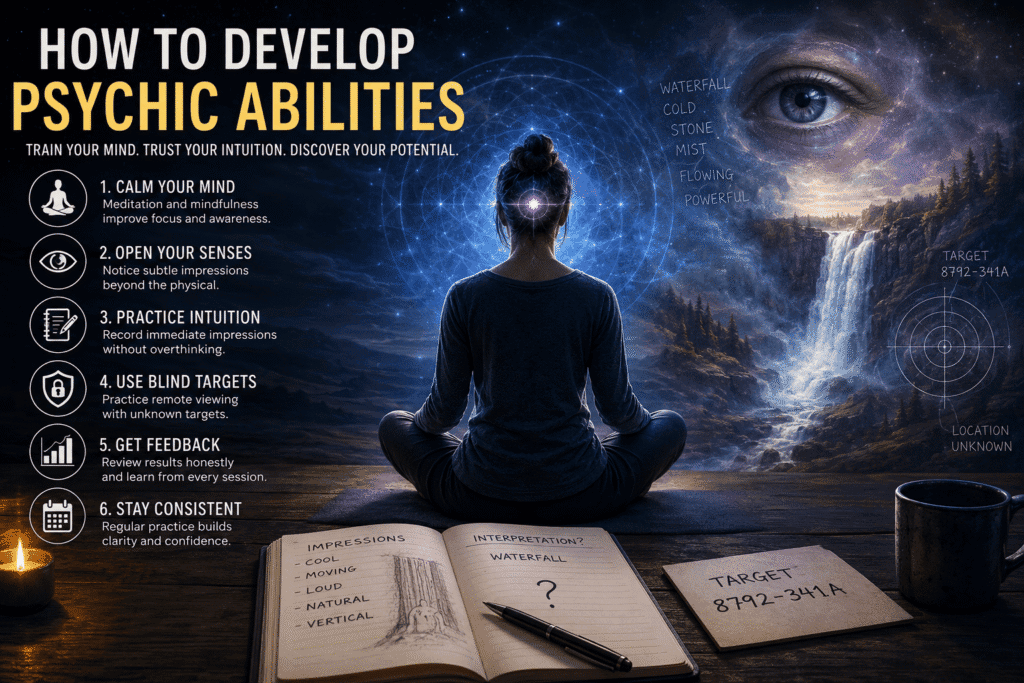
What Are Psychic Abilities?
The term psychic abilities covers many different claimed phenomena.
These can include clairvoyance, telepathy, precognition, psychometry, intuition, and remote viewing.
The problem is that when all unusual experiences are placed into one category, they’re extremely difficult to study.
If someone says:
“Sometimes I know things before they happen.”
That’s interesting, but difficult to evaluate.
How many predictions did they make?
How specific were they?
Were they recorded beforehand?
How many were wrong?
Could they have known the information normally?
Without those answers, it’s difficult to distinguish something genuinely unusual from coincidence, memory, intuition, or interpretation after the event.
That’s why I think psychic development needs feedback and testing.
Remote viewing is particularly useful for this because it can be practiced under blind conditions.
Start by Training Attention
If you’re interested in how to develop psychic abilities, one of the most useful places to begin is attention.
Sit somewhere quiet for ten minutes.
Close your eyes.
Focus on your breathing.
Your goal isn’t to force your mind to become completely empty.
Instead, notice what happens.
A thought appears.
Then another.
An image appears.
You remember something from yesterday.
You think about tomorrow.
Your mind creates an entire conversation.
Instead of following each thought, simply notice it and return your attention to your breathing.
This is basic meditation.
Meditation itself isn’t evidence of psychic functioning. But mindfulness practices can train attention and awareness, which makes them useful preparation for experiments involving subtle impressions. Many popular psychic-development guides also emphasize meditation and journaling as foundational practices.
The objective is to become better at noticing what your mind is doing.
That’s important because imagination can easily become confused with perception.
Learn the Difference Between Perception and Interpretation
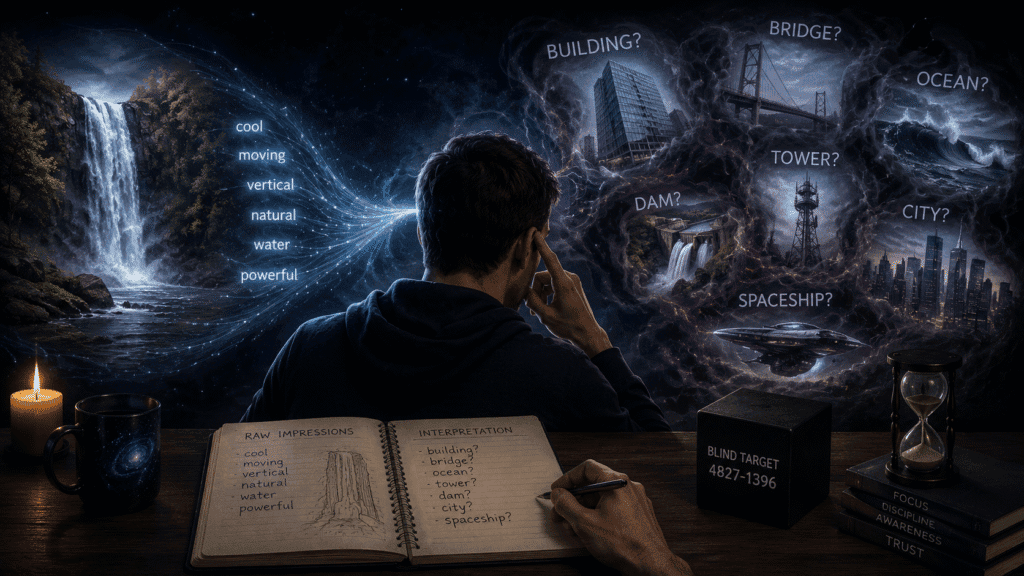
This may be one of the most important skills in remote viewing.
Imagine that during an experiment you suddenly receive:
cold
Then:
hard
Then:
tall
Then:
metallic
Your analytical mind immediately says:
“It’s a skyscraper.”
Stop.
The skyscraper is an interpretation.
The original information was:
cold — hard — tall — metallic
Those are observations.
Perhaps the target is a skyscraper.
But it could also be a radio tower.
A bridge support.
A crane.
A rocket.
A monument.
Once you decide that the target is a skyscraper, your imagination may start supplying windows, offices, elevators, people, and city streets.
Now you’ve gone from recording impressions to constructing a story.
If you want to investigate psychic ability, learn to recognize that transition.
Record the raw impression first.
Interpret later.
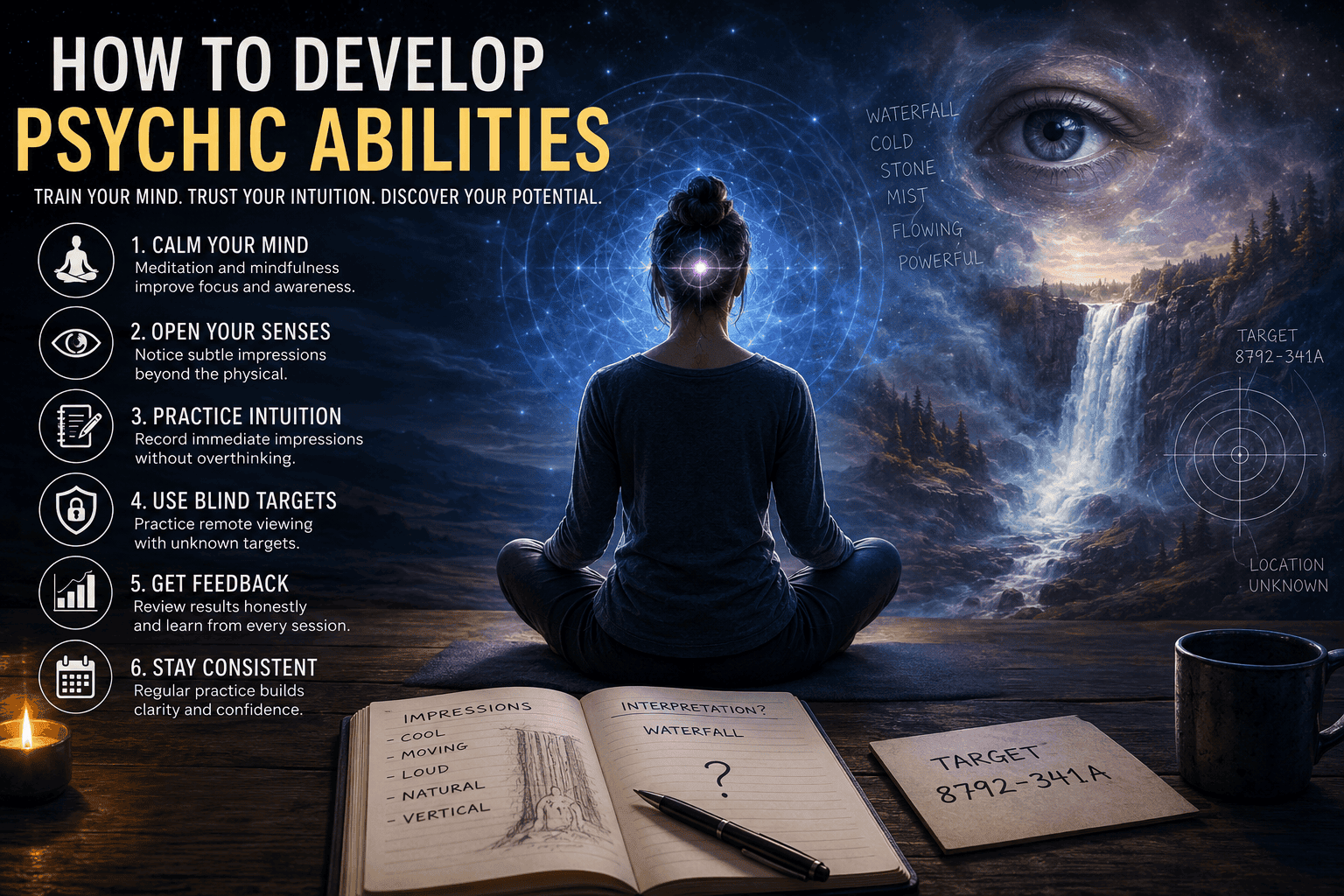
Practice With Blind Targets
Now we can turn intuition into an experiment.
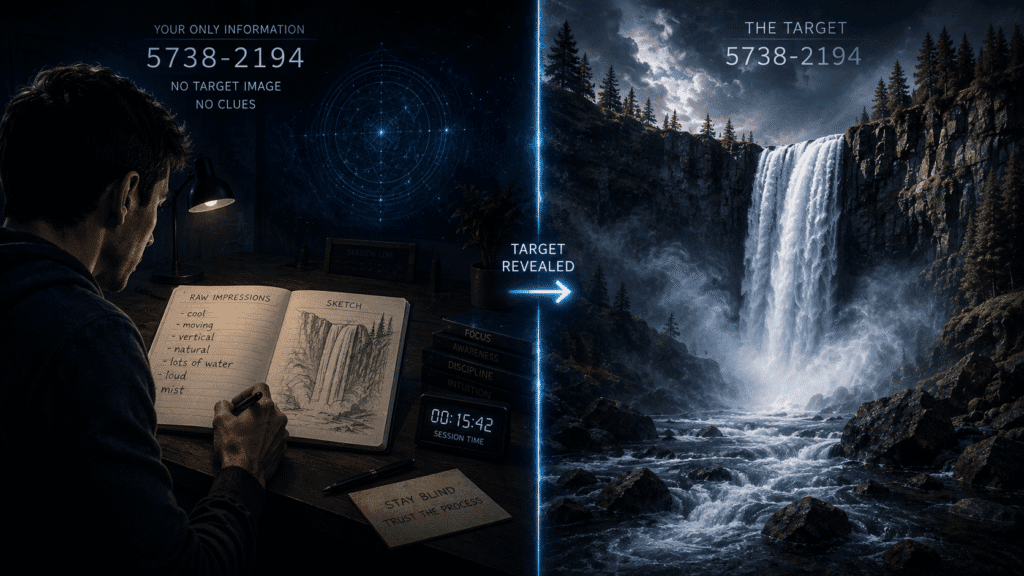
Have another person select a photograph without showing it to you.
It should be something distinctive enough to provide feedback—a waterfall, bridge, volcano, stadium, lighthouse, monument, unusual building, or similar location.
Have them assign it a random number such as:
5738-2194
You should know absolutely nothing else about the target.
Sit quietly.
Relax.
Look at the number.
Don’t try to guess what the target is.
Instead ask yourself:
What is the first impression that comes to mind?
Write it down.
Maybe:
cool
Then:
open
Then:
moving
Then:
natural
Then perhaps:
vertical
Don’t force anything.
Record whatever appears.
If you see a shape, sketch it.
If you perceive a texture, write it down.
If a color suddenly comes to mind, record it.
If you think you know what the target is, write that interpretation separately and return to basic impressions.
When you’re finished, stop.
Then—and only then—look at the target.
Feedback Is Where Training Happens
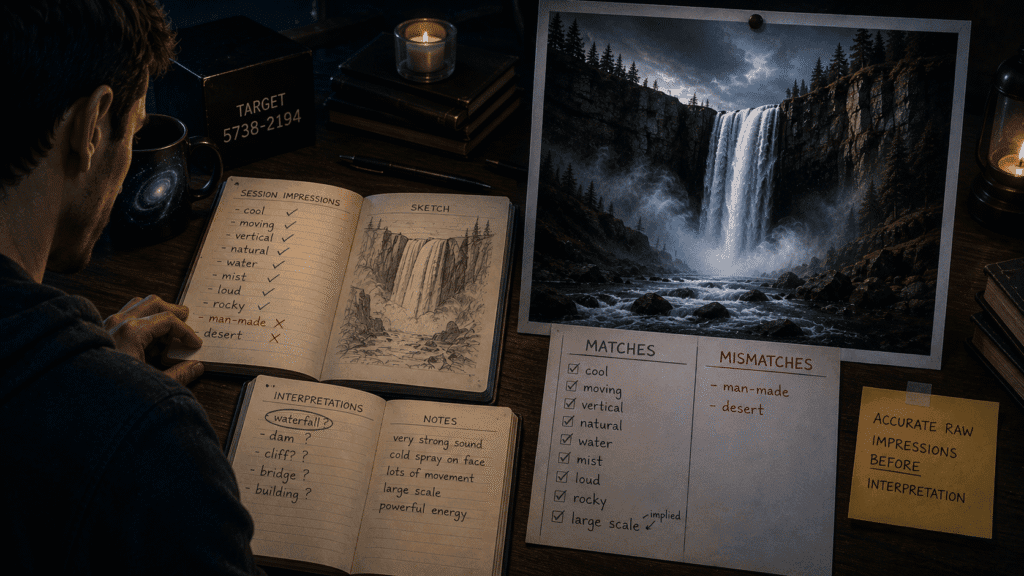
Suppose the target was a waterfall.
Your session contained:
cool
moving
natural
vertical
and a sketch showing something descending.
That’s interesting.
Maybe you also wrote:
metallic
crowded
red
Those don’t appear to fit.
Don’t ignore them.
Record both.
This is extremely important if you’re serious about learning how to develop psychic abilities.
People naturally remember impressive coincidences and forget failures.
That creates an illusion of accuracy.
Instead, keep everything.
Hits.
Misses.
Partial matches.
Complete failures.
After enough sessions, patterns may begin appearing.
Perhaps you consistently perceive temperature correctly.
Maybe you’re good at basic shapes but terrible with colors.
Perhaps visual impressions are strongest for you.
Maybe conceptual impressions work better.
You can’t discover those patterns if you only remember your best sessions.
Keep a Psychic Development Journal
Create a dedicated notebook or digital journal.
For every practice session, record:
Date
Target number
Mental state before beginning
Raw impressions
Sketches
Interpretations
Confidence level
Actual target
What matched
What didn’t match
You can also track spontaneous intuitive experiences, but write them down before you know whether they’re correct whenever possible.
This prevents memory from rewriting the experience afterward.
Journaling is frequently recommended in psychic-development material because it creates a record that can later be reviewed for patterns.
But I would take it one step further:
Don’t use the journal only to remember your successes. Use it to measure your failures.
That’s what makes it useful.
Train Your Visual Imagination Separately
Some people naturally think visually.
If you want to strengthen visualization, practice it separately from blind psychic experiments.
Close your eyes and imagine a red apple.
Try to see its shape.
Rotate it.
Change it to green.
Imagine cutting it in half.
Look at the inside.
Now imagine a cube.
Rotate the cube.
Change its size.
Move it farther away.
This doesn’t prove or develop paranormal perception by itself.
What it does is help you understand what deliberately generated imagery feels like.
That’s valuable.
If you’re practicing remote viewing and an unexpected image appears, you can compare that experience with imagery you consciously created.
Learning how your imagination behaves may help you distinguish deliberate visualization from spontaneous impressions.
Practice Sensory Awareness
Do the same thing with your other senses.
Pick up an object.
Close your eyes.
Notice:
temperature,
weight,
texture,
hardness,
shape,
pressure.
Then listen to your environment.
Try to identify the most distant sound you can hear.
Then the closest.
Notice smells.
Notice changes in temperature.
Notice physical sensations you’re normally ignoring.
This isn’t necessarily psychic training.
It’s perceptual training.
But if psychic information does appear through subtle sensory-like impressions, becoming more familiar with your normal sensory and imaginative experiences may make unusual impressions easier to identify.
Test Intuition With Simple Predictions
You can also practice with events where the answer will become known quickly.
For example, use a properly randomized process to choose between several images or targets without seeing the selection.
Before revealing the answer, write down your impression.
Don’t simply think:
“I think it’s number three.”
Record the actual experience that led you there.
Maybe you experienced:
bright
round
outside
yellow
Then reveal the target.
Was there a match?
Repeat.
The important part isn’t whether you get one impressive result.
It’s what happens after dozens or hundreds of trials.
A single coincidence proves very little.
Repeated performance under controlled conditions becomes much more interesting.
Don’t Practice by Guessing Who Is Calling
You’ll sometimes hear psychic-development advice suggesting that before answering your phone, you should guess who’s calling.
That’s fine as a game, but it’s a poor experiment.
You already know who’s likely to call you.
Your brain knows what time people usually contact you.
It recognizes patterns.
It may have seen notifications.
Your subconscious may have information your conscious mind hasn’t noticed.
Instead, create experiments where you genuinely cannot know the answer normally.
That’s why blind target selection is so valuable.
Remove conventional information whenever possible.
Treat the Analytical Mind as Noise
Imagine you’re trying to hear a whisper while someone next to you is shouting.
The whisper might be there.
But the louder voice overwhelms it.
Something similar can happen during remote viewing.
An initial impression might be:
large
The analytical mind responds:
BUILDING!
Then:
open
The mind says:
AIRPORT!
Then:
moving
Now it decides:
AIRPLANE!
Soon you’re describing an airport even though the actual target could be a large waterfall.
If anomalous information exists, one possibility is that it’s subtle.
The problem may not simply be receiving information.
The problem may be preventing our own expectations from overwhelming it.
That’s why structured remote-viewing methods place so much emphasis on managing analytical interpretation.
Think in Terms of Signal and Noise
As someone interested in technology, this is the model I find most useful.
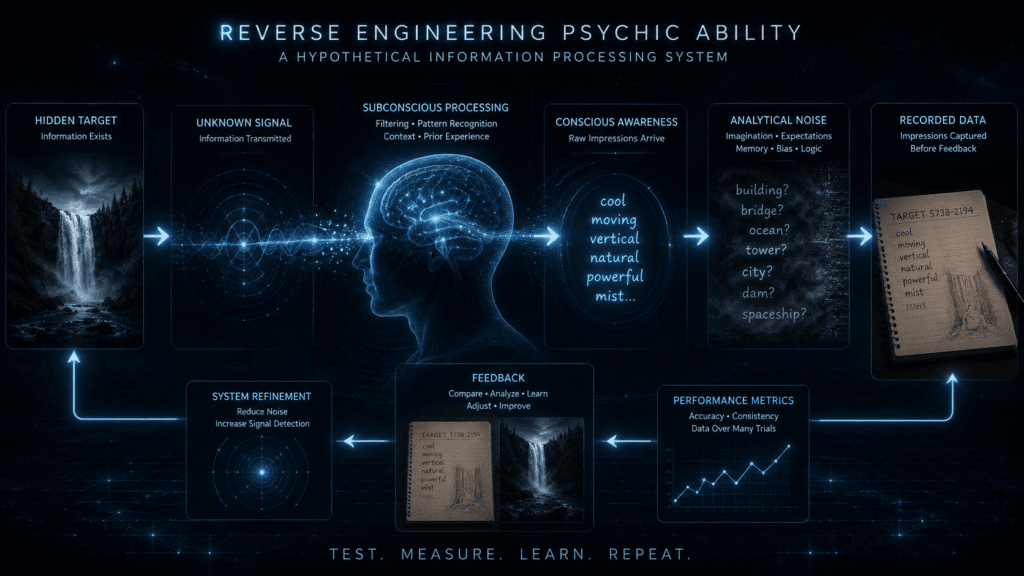
Imagine psychic ability as a hypothetical communication system.
There is a target.
There may or may not be some information signal.
Your subconscious processes something.
Information reaches conscious awareness.
Then noise enters.
The noise could include:
imagination,
expectation,
memory,
fear,
desire,
previous targets,
environmental distractions,
leading questions,
or simply trying too hard.
If you want to understand how to develop psychic abilities, don’t just try to increase the hypothetical signal.
Try to reduce the noise.
That’s a much more manageable problem.
Develop Your Strongest Channel
Different people process information differently.
Some people naturally think in pictures.
Others think verbally.
Some are extremely sensitive to sound.
Others notice spatial relationships, movement, textures, or emotional atmosphere.
The same differences may appear during remote-viewing practice.
You might discover that your strongest information is visual.
Another person might consistently identify:
temperature
texture
movement
size
without seeing clear mental imagery.
Don’t assume psychic information, if it exists, must arrive as dramatic visions.
It may appear as extremely subtle impressions.
Training means discovering how information tends to appear for you.
Don’t Chase Dramatic Experiences
One of the biggest mistakes in learning how to develop psychic abilities is expecting something spectacular.
People imagine visions appearing like movies.
That expectation can become a problem.
If you’re waiting for a crystal-clear image of the target, you may ignore subtle information such as:
cool
rough
open
vertical
moving
Those impressions seem boring.
But imagine the target is Niagara Falls.
Suddenly they become extremely relevant.
Don’t demand dramatic information.
Record simple information.
Accuracy is more important than excitement.
Don’t Turn Every Coincidence Into Evidence
Once people become interested in psychic phenomena, something interesting can happen.
Everything begins looking significant.
Repeating numbers.
Dreams.
Coincidences.
Random thoughts.
Unexpected phone calls.
Sometimes these experiences can feel extraordinary.
But human beings are powerful pattern-recognition machines.
We notice meaningful coincidences and forget enormous numbers of meaningless ones.
That’s why documentation matters.
Instead of immediately deciding:
“That was psychic.”
Write it down.
Ask:
Could I have known this normally?
How specific was the impression?
Was it recorded beforehand?
How many times was I wrong?
Curiosity and skepticism can coexist.
In fact, they should.
Don’t Use Psychic Impressions for High-Stakes Decisions
If you’re experimenting with intuition or remote viewing, keep the practice separate from important medical, financial, legal, or safety decisions.
Don’t stop medication because of an impression.
Don’t invest money because you dreamed about a stock.
Don’t accuse someone of something because you “sensed” it.
Don’t make a dangerous decision because a remote-viewing session appeared to suggest it.
Use appropriate evidence and qualified professionals for high-stakes decisions.
Psychic-development practice should be treated as experimentation—not as a replacement for ordinary judgment.
Can Meditation Help Develop Psychic Abilities?
Meditation appears repeatedly in discussions of how to develop psychic abilities, including guides that pair it with intuition exercises and remote viewing.
But we should separate two claims.
Meditation can help train attention and change your relationship with thoughts.
That doesn’t automatically mean meditation produces paranormal abilities.
For remote-viewing practice, however, learning to sit quietly and notice impressions without immediately reacting to them can be extremely useful.
Think of meditation as training the observer.
You’re learning to watch what enters awareness.
That’s valuable whether the source turns out to be intuition, subconscious processing, imagination, or something genuinely anomalous.
How Often Should You Practice?
Consistency matters more than marathon sessions.
You might begin with:
10–15 minutes of meditation
followed by:
one short blind target
a few times each week.
Don’t spend hours forcing yourself to perceive something.
Fatigue can increase imagination and reduce concentration.
Complete the session.
Get feedback.
Record the results.
Move on.
After several weeks, review your journal.
Look for patterns.
Then adjust your training.
A Simple Psychic Development Experiment
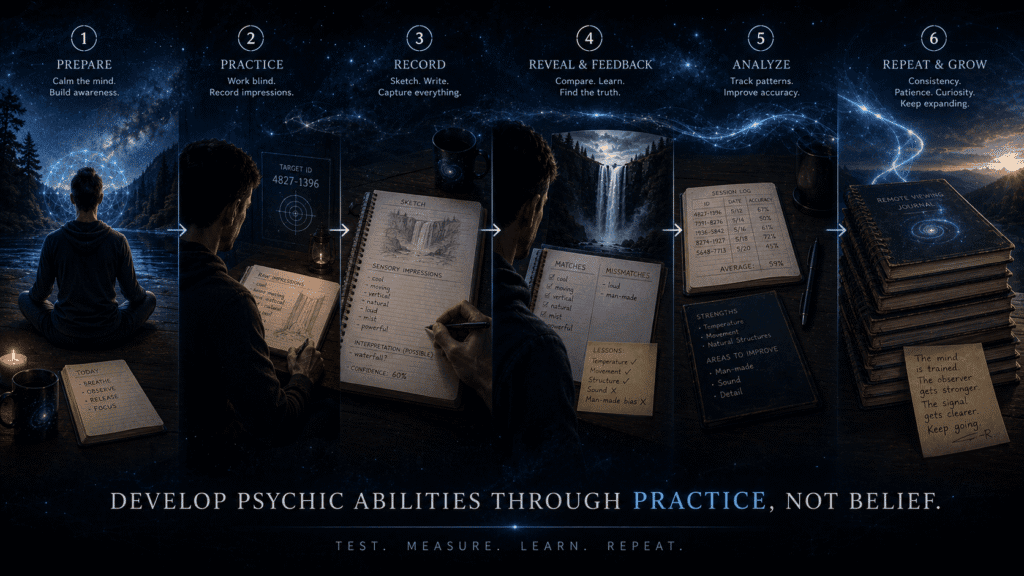
If I were starting from zero and wanted to investigate how to develop psychic abilities, I would begin like this:
Step 1 — Quiet the mind
Meditate for approximately ten minutes.
Step 2 — Use a blind target
Have another person or a properly designed system randomly select a target that you cannot see.
Step 3 — Record first impressions
Write down sensory information before trying to identify anything.
Step 4 — Sketch
Draw shapes, spatial relationships, or movement without worrying about artistic ability.
Step 5 — Separate interpretation
If you think you know the target, label that thought separately instead of allowing it to control the session.
Step 6 — Stop
Don’t keep working simply because you want more information.
Step 7 — Reveal the target
Only after the session is complete.
Step 8 — Compare
Identify matches and misses.
Step 9 — Save everything
Never throw away bad sessions.
Step 10 — Repeat
One session means almost nothing.
Patterns across many sessions are what matter.
Can Anyone Develop Psychic Abilities?
Many psychic-development traditions claim that everyone possesses some level of psychic potential, while some people appear naturally stronger than others. Current popular guides commonly frame these abilities as skills that can be strengthened through consistent practice.
Scientifically, however, we cannot simply assume that paranormal psychic ability exists in everyone.
That’s something experiments would need to demonstrate.
But we already know that several abilities involved in these practices can be trained:
attention,
observation,
visualization,
pattern recognition,
self-awareness,
meditation,
and awareness of internal mental processes.
The interesting question is whether training these ordinary abilities eventually reveals something extraordinary.
Psychic Ability May Be More Like Music
Imagine psychic ability works more like musical ability than an on/off switch.
Most people can learn rhythm.
Many people can learn an instrument.
Some people have stronger natural ability.
Training still matters.
Feedback matters.
Practice matters.
But not everyone becomes Mozart.
Perhaps psychic functioning, if genuine, works similarly.
Instead of asking:
“Am I psychic?”
the better question might be:
“What is my baseline ability, and does controlled training improve it?”
That question can actually be tested.
Reverse Engineering Psychic Ability
This brings us back to the idea that originally fascinated me.
If psychic ability exists, perhaps the best way to understand it isn’t by making it more mysterious.
Maybe we should do the opposite.
Reverse engineer it.
Break it into components.
Study attention.
Study intuition.
Study imagination.
Study subconscious processing.
Study analytical interference.
Control the target.
Measure the results.
Identify the noise.
Provide feedback.
Repeat the experiment.
Perhaps we’ll discover that many experiences traditionally described as psychic have conventional psychological explanations.
Perhaps we’ll discover that human intuition is much more powerful than we currently appreciate.
Or perhaps controlled experiments will continue producing information that our existing models struggle to explain.
Any of those outcomes would teach us something.
How to Develop Psychic Abilities Without Starting With Belief
If you want to know how to develop psychic abilities, I don’t think you need to begin by believing you’re psychic.
Begin with curiosity.
Train your attention.
Meditate.
Learn how your imagination behaves.
Practice distinguishing raw impressions from interpretations.
Use blind targets.
Record everything before feedback.
Track the failures alongside the successes.
Look for patterns over dozens of sessions rather than celebrating individual hits.
And remain willing to change your mind.
If nothing unusual happens after extensive controlled testing, that’s valuable information.
If something unusual repeatedly happens under conditions designed to prevent normal access to the information, that’s valuable information too.
The objective shouldn’t be to convince yourself that you possess psychic abilities.
The objective should be to discover what your mind can actually do.
Because if there really is a signal hidden beneath imagination, expectation, and analytical noise, developing psychic ability may not require believing harder.
It may require learning how to listen better—and testing whether what you hear is actually there.